$15,474. That's what America spends per person on healthcare, more than double the UK's roughly $6,747 per capita.[1]
For HealthTech founders in the UK and beyond, the gap represents the largest commercial opportunity in global health. But here's what the statistics don't show: the vast majority of UK digital health companies fail to capture the opportunity. As an American healthcare executive now embedded in the UK innovation ecosystem, I've seen what separates the winners from the cautionary tales.
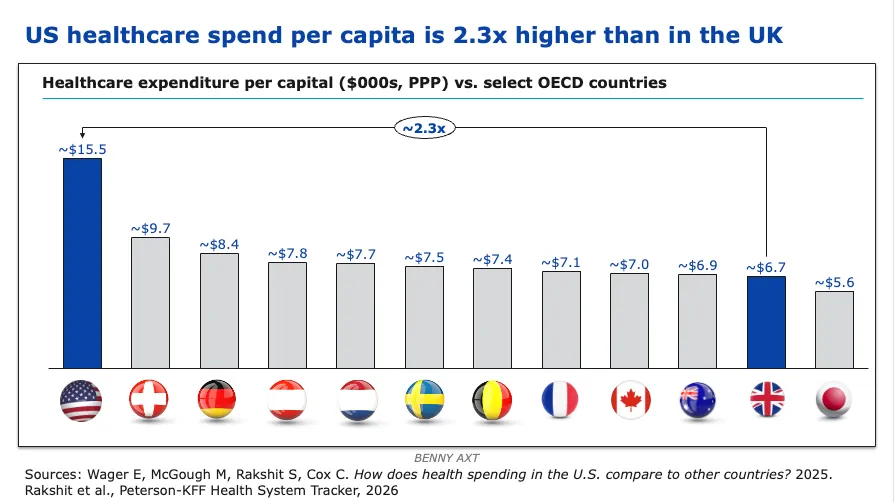
The allure is obvious: beyond the spending gap, the US has a fast-paced innovation culture that rewards bold bets. Most digital health startups eventually set their sights on America. But entering the US market can be as challenging as it is attractive. In this article, I'll share hard-won strategies and data on US market entry to help founders navigate the journey and minimise unwanted surprises.
Why UK HealthTech Founders Continue To Look West
The United States spends more on healthcare than any other nation. An estimated $5.6 trillion was spent in 2025, approximately 18% of Gross Domestic Product.[3]
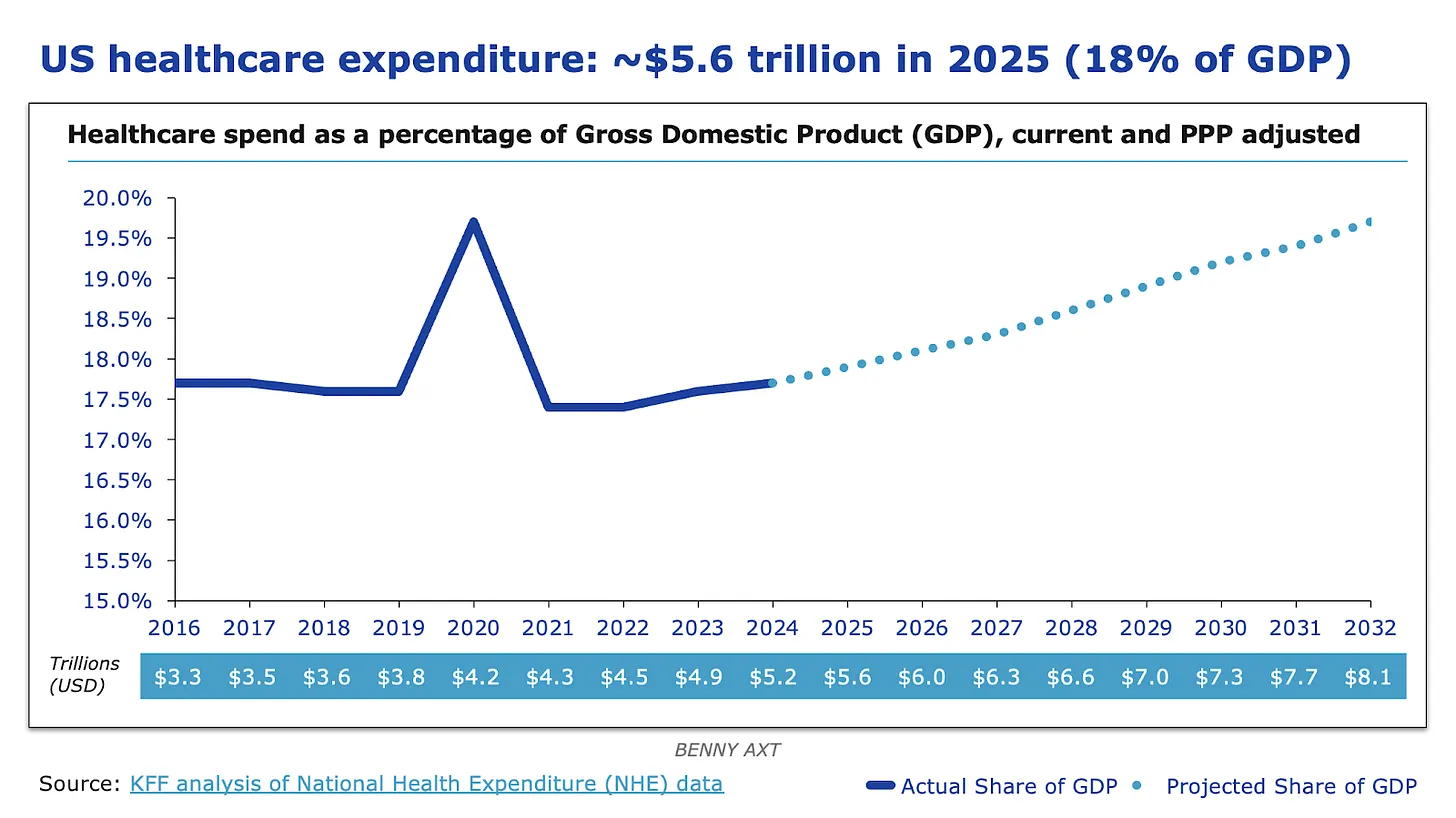
For UK HealthTech founders, the timing has never been better, or more urgent.[4] The US healthcare system is under unprecedented pressure to reduce costs while improving outcomes, creating openings for innovative solutions. The 2024 expansion of Medicare coverage for digital therapeutics has opened new reimbursement pathways.[5] Meanwhile, UK companies bring something American startups often lack: evidence of real-world effectiveness within a national health system. NHS validation can be a differentiator if you know how to translate it.
The US healthcare system's scale (340 million people) and high per-capita spending mean a successful solution can access a much larger revenue pool than in smaller markets. The sheer size of the prize, in terms of funding, customers, and partners, makes the US incredibly attractive for global HealthTech innovators.
3 Key Challenges in the US Market: Culture, Regulation, and Payment
Entering the US healthcare market requires understanding how it fundamentally differs from the UK:
Cultural Nuances
While the US and the UK share a common language, the cultural gulf is wider than one might think. Complex decision-making units are an integral aspect of the sales process when seeking to win over employers, hospitals, and insurance carriers.
I was involved with the sale of a SaaS wellness solution to a leading North American insurance provider. The discussions took 6+ months and involved multiple site visits, including one full-day meeting at our HQ with 15+ executives flying in from 3 different areas of the business. Identifying true budget holders early is critical. Timely follow-ups, explicit asks, and visible momentum are cultural signs of seriousness. For solutions that have been built in the UK, US clinicians may also expect validation on American patient populations, who often behave like consumers, making decisions based on deductibles and co-pays.
The surge of direct-to-consumer healthcare ads during this year's Super Bowl, from telehealth platforms to prescription weight-loss brands, underscores just how aggressively healthcare is marketed like any other consumer product in the US. Your value proposition must speak to that consumer mindset, not just the clinical efficacy of your solution.
Regulation Pathways
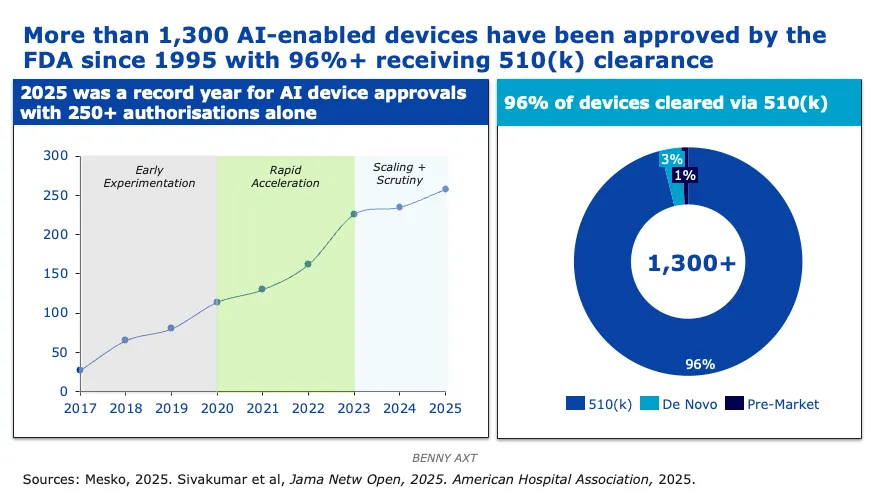
Food and Drug Administration (FDA) approval, or clearance, is often mandatory to commercialise in the US. The process differs from UKCA or CE marking, often requiring more extensive US-specific evidence, particularly for novel AI or digital therapeutics.
But FDA clearance is only the first gate; it determines whether a product can be marketed, not whether it will be reimbursed. Reimbursement typically depends on coding decisions made by the American Medical Association (AMA), which issues CPT codes, and payment rates set by the Centers for Medicare & Medicaid Services (CMS). Among the 1,350+ AI-enabled medical devices with FDA clearance, very few of these tools are actively reimbursed. In January 2026, Medicare began paying doctors more than $1,000 for the use of AI that analyses coronary plaque.[6] It's one of only 3 AI tools that have received a Category I CPT code. UK entrepreneurs should frame their regulatory strategy not just around clearance, but around coding, coverage, post-market evidence generation, liability exposure, and alignment with provider incentives.
Reimbursement
In the UK, the NHS is often the primary customer, but in the US, new market entrants face a complex payer landscape. Revenue might come from private insurance companies, Medicare/Medicaid (government programs), employer health plans, or patients directly, each with distinct adoption criteria.
Relative Value Units (RVUs) are often how physicians get paid under fee-for-service healthcare, and products that protect or increase RVU capture tend to gain faster adoption. The rapid uptake of ambient AI documentation tools like Nuance's DAX and Abridge illustrates this: by automating note generation, they allow physicians to reduce admin time and see more patients, creating a clear financial return.
Strategies for Successful US Market Entry
Plan Early for FDA and Clinical Evidence
Map out your FDA regulatory pathway as early as possible. Engage via programs like Breakthrough Device Designation or informal pre-submission meetings to clarify requirements. Be ready to conduct US-based clinical trials or real-world studies. US regulators and customers will expect evidence that your solution works for American patients.
Cambridge-based CMR Surgical is a strong example. After receiving CE mark approval in 2019, they built substantial international evidence with 26,000+ procedures across Europe, Latin America, Asia, the Middle East, and Africa.[8] In October 2024, CMR's product, the Versius Surgical Robotic System, became the first multi-port soft tissue robotic device to gain FDA de novo clearance, followed by 510(k) clearance for the Versius Plus in December 2025.[9] The company had raised approximately $1 billion, including a $600 million round in 2021, to support this expansion.
Leverage Pilot Programs and Beachheads
Many UK startups enter the US by first securing a pilot contract with a single reputable US institution. Programs like the ABHI US Accelerator offer mentorship and introductions, and diaspora networks (Americans in Oxford or UK founders who have expanded stateside) can be a valuable source of support. Kneu Health, an OSE portfolio company, found that participation in the Cedars-Sinai Accelerator provided direct access to clinicians, pilot opportunities, and guidance on market complexity. A strong beachhead market, or key partner, lets you refine your product-market fit and signals commitment to the market.
That said, beware of the “pilot purgatory” trap. Set clear success metrics upfront: including what triggers a commercial contract, the timeline for conversion, and who holds budget authority.
Understand the Payment Model and Your Value Proposition
Frame your solution around cost savings or revenue gains for providers. If your product reduces hospital readmissions, quantify the cost savings under US reimbursement codes. If it improves outcomes, show how it helps a clinic perform under value-based care programs. Health economic analyses that translate UK success into US dollars saved can be persuasive.
Build a Local Team and Partnerships
Hire a US-based lead or adviser who has navigated healthcare commercialisation before. Their network can open doors with health system executives or payer innovation teams. You'll also need practical infrastructure: a US entity (typically a Delaware C-corp for venture capital compatibility), and key hires will require appropriate visas, such as L-1 for intracompany transfers or O-1 for “extraordinary ability.” Establishing a local entity also simplifies equity grants for hiring senior executives, tax treatment, contracting with payers and providers, and investor due diligence. Many UK companies stumble by trying to operate from London for too long. Without decision-makers on the ground, it is difficult to build relationships, close enterprise deals, or recruit top-tier commercial talent.
Be Ready to Scale and Adapt
Initial growth in the US should be viewed from a hyper-localised perspective in terms of geography, patient populations, and the unique needs of providers and payers. If your US beachhead goes well, be prepared to scale up quickly. The US market can amplify demand overnight, so ensure you have the operational capacity to meet growing US demand.
Also, stay ready to iterate: integrating with Epic or Cerner Electronic Health Records is often critical for hospital-facing digital health tools, and the US sub-market can have distinct needs.
Final Thoughts
Breaking into the US healthcare market demands patience, investment, and adaptation. But it can also serve as a launchpad to transform a UK HealthTech startup into a global leader. America's healthcare system, for all its complexities, rewards innovation that can improve outcomes or reduce costs at scale, and UK founders bring world-class science and resourcefulness from operating under NHS constraints.
Treat US market entry not as an afterthought, but as a core part of your strategic bet: gather data, talk to experts, and perhaps most importantly, build relationships on the ground. The opportunity is real, but so are the challenges. Success comes to those who prepare thoroughly and adapt quickly.
About the Author

Benjamin (Benny) Axt
Entrepreneur-in-Residence, Oxford Science Enterprises
Benny is Oxford Science Enterprise's first Entrepreneur-In-Residence to join from the US, bringing more than 15 years of experience in healthcare strategy, operations, and international expansion. He has lived and worked in healthcare systems on 6 continents, supporting providers, payers, regulators, and patients to improve access, outcomes, and economics.
Previously, Benny served as Vice President of Strategy at Dialogue Health Technologies Inc., where he supported US market entry and helped grow the company from a venture-backed startup to IPO and acquisition by Sun Life. He also held leadership roles at DaVita, a Fortune 500 healthcare provider, and has advised multiple early-stage digital health startups as a consultant and board adviser.
Benny holds a Master of Health Care Delivery Science from Dartmouth College, an MBA from Thunderbird School of Global Management, and a BA from the University of Wisconsin-Madison.
Sources
- [1]Organisation for Economic Co-operation and Development (OECD). Health at a Glance 2025: United Kingdom profile. Link
- [2]Peterson-KFF Health System Tracker. Total national health expenditures as a percent of GDP, 1970–2024. Link
- [3]Peterson-KFF Health System Tracker. Total national health expenditures as a percent of GDP, 1970–2024. Link
- [4]Rakshit S, Winger A, Cotter L, McGough M, Wager E, Cox C. How has U.S. spending on healthcare changed over time? Peterson-KFF Health System Tracker. Published January 22, 2026. Link
- [5]Stringer H. New reimbursement pathways have opened doors for using digital therapeutics. APA Services; November 12, 2025. Link
- [6]Palmer B. Who will pay for AI in health care? 3 trends to watch in 2026. STAT. 2026. Link
- [7]Mesko B. The current state of over 1,250 FDA-approved AI-based medical devices. The Medical Futurist. 2025. Link
- [8]CMR Surgical. CMR receives FDA marketing authorization for Versius Surgical System. 2024. Link
- [9]Hale C. CMR Surgical grabs FDA clearance for upgraded Versius Plus robot. Fierce Biotech. December 17, 2025. Link