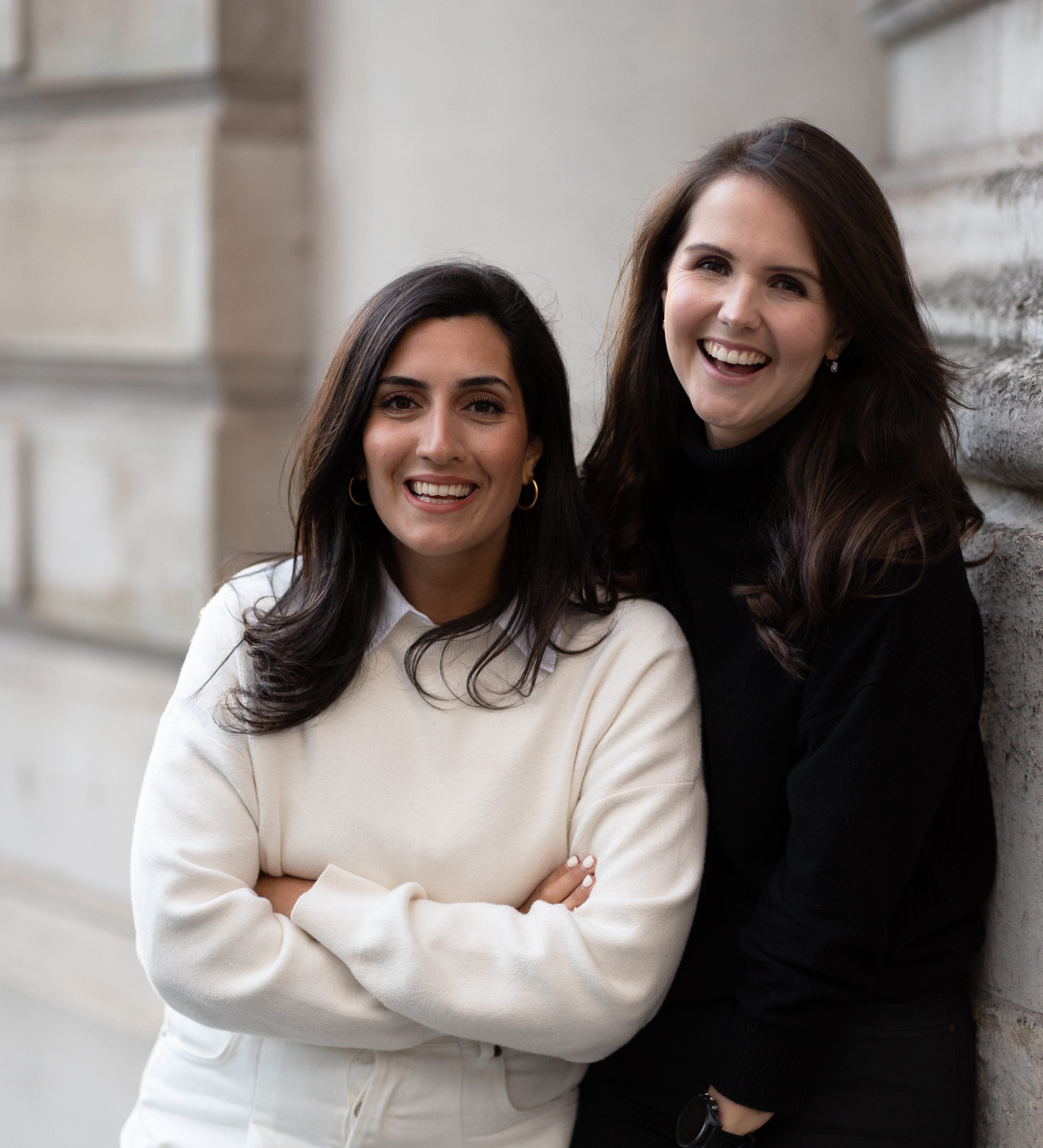
Jas Schembri-Stothart was not supposed to be an entrepreneur.
Her parents, who immigrated from Lebanon and Malta, had a clear script: doctor, lawyer, or engineer. Something stable. Something that made money. Jas followed that script, Barclays Capital, then Deloitte, then an Oxford MBA, which she funded by continuing to consult on the side. Even the MBA wasn't really a departure. “I always thought I'd go to a scaleup,” she tells me. “Or maybe explore the VC route. I never thought I'd find myself co-founding something.”
The thing that changed her mind was a question. During an MBA assignment, form a team, find a problem, pitch it, an Octopus Ventures investor on the panel looked at their idea, a health app for teenage girls, and asked who was going to do something with it once the programme ended. Jas's co-founder, Jo, scheduled lunch with her shortly after. Jo wanted to build it, but Jas was not immediately convinced.
“Part of me felt envious. Like, oh my God, she could go and do this and have this really successful company. But the other part of me just thought, how do we even start?”
She told Jo she'd consider it on one condition: they had to actually talk to the users first. But their product idea was built for teenagers, so they couldn't do so during the MBA, both had signed a document prohibiting contact with under-18s for research purposes. So over the following six to eight weeks, they rang every teacher they knew and ran workshops in their old schools. The teenagers asked where they could download the app. Some asked about the co-founders' work experience.
“That was the final piece that pushed me to do this. These potential users would actually really like to use this.”
From Classroom to Company
The original idea of luna was a period tracker, with parents on the platform alongside their teens to help bridge communication gaps. The workshops dismantled both assumptions quickly. Teens said periods were only one part of a difficult adolescence, they wanted help with mental health, body image, acne, sleep, friendships, all of it in one place. They were equally unambiguous about the parent layer. They would never use the app if their parents were on it with them. Never.
luna listened, and they broadened the product and removed parents entirely.
Then the data said something the workshops hadn't. Teens introduced to luna by a parent turned out to be four times more active than teens who found it themselves. Jas and her team went back and investigated why. The answer was almost mundane: the teens who'd discovered luna on their own were too shy to send their parents the link and ask them to pay. They sat on the free tier instead, with its more limited experience, and drifted. Having a parent introduce the app felt, as Jas puts it, like permission.
“Like, my parent knows I'm using this, and they're okay with it.”
The parent companion layer is now central to how luna monetises. Parents can't see what their teens are up to on the app, but receive general insights based on the wider teen cohort. luna's conversion rate from download to subscription, driven largely by parents paying, sits at around 40%.
“It went against what all these kids had told us.”
The methods have had to scale with the product, the school workshops that produced that original insight have evolved into surveys, online sessions, and one-to-one user calls. But the instinct is the same: go back and ask. As she explains their journey to me, Jas sounds like someone who has made peace with the idea that users will surprise you, repeatedly, and that this is mostly a good thing.
No Cringe Allowed
luna now has a network of nearly 250 teen brand ambassadors feeding real-time product feedback. Jas is candid about why: she and Jo are millennials building for Gen Z, and they know the gap that creates.
“We're not going to get this right on just our own.”
When luna did its one significant branding exercise, the colour palette, the fonts, the tone of voice, teens were in the room. The goal, as Jas puts it, was that teens would be proud to have the app on their phone. Not just willing to use it, but proud.
That's a harder brief than it sounds for a health product. Jas describes the aim as sitting at the crossroads of trustworthy and cool, something that doesn't make a teenager cringe when a notification pops up in class. “We knew from the jump it had to be a cool brand.”
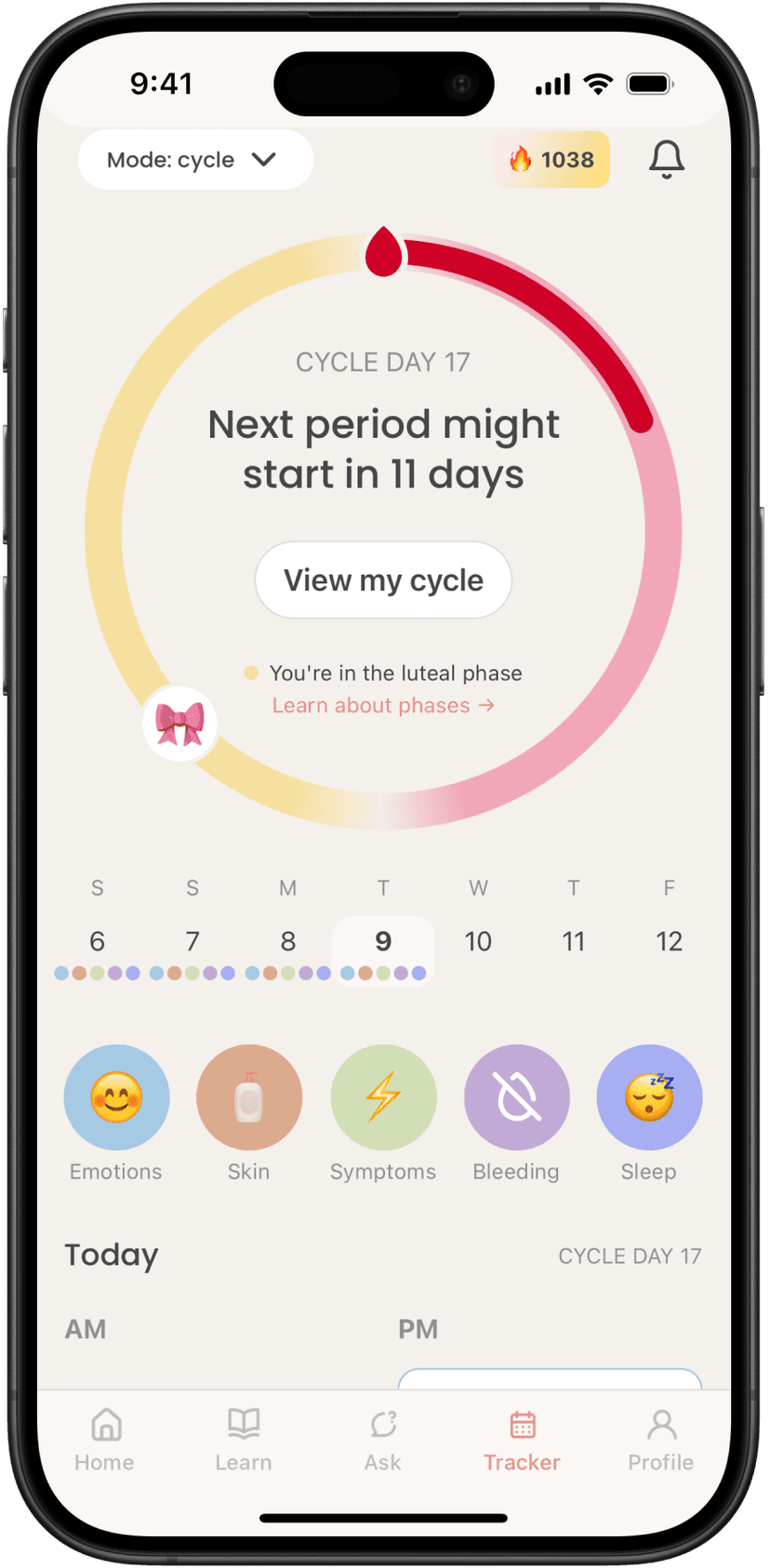
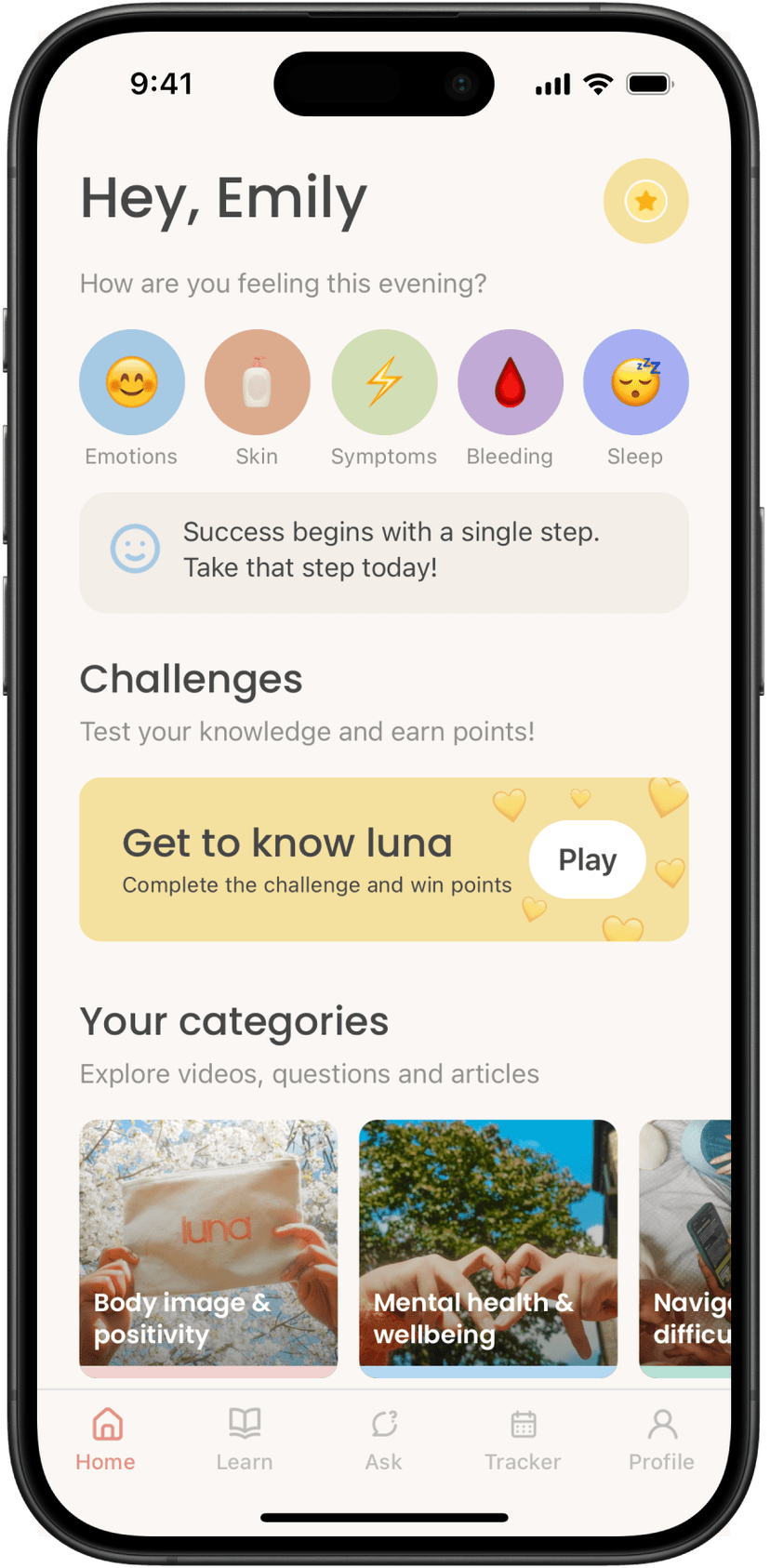
luna's cycle tracking and home screens
The channel strategy followed the same logic, though it came later, when monetisation forced them to think harder about parents. Before last year, luna only targeted teenagers. “It was only when we started to focus on monetisation that we realised parents do need to be in the loop, they're the ones actually paying for it.”
Now luna's TikTok is built entirely around teens — teen-led and community-focused, the kind of content that feels like it's been made by the audience it's for rather than a brand trying to speak to them. The website and Instagram are aimed at parents, but with one constraint.
“We try our best not to be cringy.”
Teens do end up on Instagram and the website. They Google “period tracker for teens” or “mental health app for teens” and land on the website. The parent-facing channels can't be so calibrated towards mums and dads that they alienate the teenagers who stumble across them. It's a balance luna admittedly hasn't fully cracked. Jas is also straightforward that luna's Instagram isn't right yet. “Our Instagram had been built on the premise of focusing on teenage girls. We had to completely retrain the algorithm now that we are communicating to parents too. There's still a lot more work to be done.” When you're a team of seven, she says, you pick your battles.
Building Without a Technical Blueprint
Neither Jas nor Jo had a technical background when they started luna. The biggest sticking point with early investors was the absence of technical expertise on the team. “We had to prove to them, look, we might not be able to write code, but we can do stuff in no-code.” Jo built the first version of the app herself, got a hundred teenagers on it, drawn from the schools they'd visited, and put that data in the pitch deck.
What's interesting in retrospect is how much that constraint may have shaped the product. Without an engineering instinct to reach for, every early decision had to be justified by what users actually wanted. The focus group in the founder's old schools. The 250-person ambassador network. The branding workshop where teens picked the colours and fonts. The parent layer that got stripped out and quietly rebuilt when the data made the case. luna's product history reads more like a long, ongoing conversation with its users, which may be exactly what a health app for teenagers needs to be, not just for this generation, but for future generations too. Technical founders build features. Jas and Jo kept asking questions.
From Oxford and Beyond
luna was born out of a classroom at Oxford's Saïd Business School, and the ecosystem gave them more than just the idea. Jas credits the MBA classmate network, people who had started businesses before and were generous with their time, as well as an Oxford adviser directory that connected them with VCs, exited founders, and consultants willing to take meetings in their first year. The Oxford Seed Fund invested in the second year of operations.
“I think we wouldn't have had those connections if we didn't choose to go to Oxford.”
But she's clear-eyed about the limits of it. The MBA taught them some things, but building and running a company from scratch was something you can't learn just from textbooks and class projects. The practical knowledge came from leaning on people, asking questions, and figuring it out as they went.
luna raised its pre-seed from Octopus and SyndicateRoom. When asked about the environment that makes the UK a suitable place to start a business, Jas noted that the SEIS/EIS tax relief[1] is a genuine structural advantage for early-stage fundraising, one she'd known nothing about until she started raising, and which international investors consistently flag as something they wish existed in their own markets. But valuations in the UK are lower than the US, risk appetite is lower, and the density of female angel investors doesn't yet compare.
“I spent some time in the US last year, and I'm back and forth there often. There were a lot more female angel groups, successful women deploying into female-owned startups. There's talk of that here, and some groups and initiatives forming, but it's not on that level.”
On regulation — GDPR and the UK's Age Appropriate Design Code — she's a lot more positive than most founders in her industry. “I don't really see it as a blocker because we've always had to deal with it. If anything, it gives us an advantage.” Partners in other parts of the world are excited about luna's compliance rigour because European data standards are more stringent.
None of this, the regulatory navigation, the dual-audience marketing, the fundraising without a CTO, was what Jas had in mind when she enrolled at Saïd Business School. She wanted a stable next step. She got something harder and, by her own account, considerably better.
“I never really thought the entrepreneurial path was what I would go down. But I love my job. It's extremely hard. It's ups and downs; you have to be really resilient. But I come to work happy every single day.”
This article was written by Nessie Chu-Heng Lu, Strategic Marketing Lead, Founders & Funders.
- [1]SEIS and EIS are UK government-backed venture capital schemes designed to encourage individuals to invest in small, high-risk startups by offering significant tax incentives, including Income Tax, Capital Gains, and Inheritance Tax reliefs.
About the Founder

Jas Schembri-Stothart
Co-Founder, luna
Jas Schembri-Stothart is the Co-Founder of luna, a digital wellbeing companion helping teen girls navigate adolescence with confidence. Designed as a trusted “big sister in your pocket,” luna delivers medically vetted guidance across the physical, emotional and social challenges of growing up through expert content, moderated Q&A and safety-first design. As more teens turn to social media for answers about their health and wellbeing, luna provides a trusted alternative, delivering preventative health education at scale.
Jas is a former consultant turned entrepreneur and holds an MBA from Oxford Saïd Business School. She also sits on the governing board of her former high school.