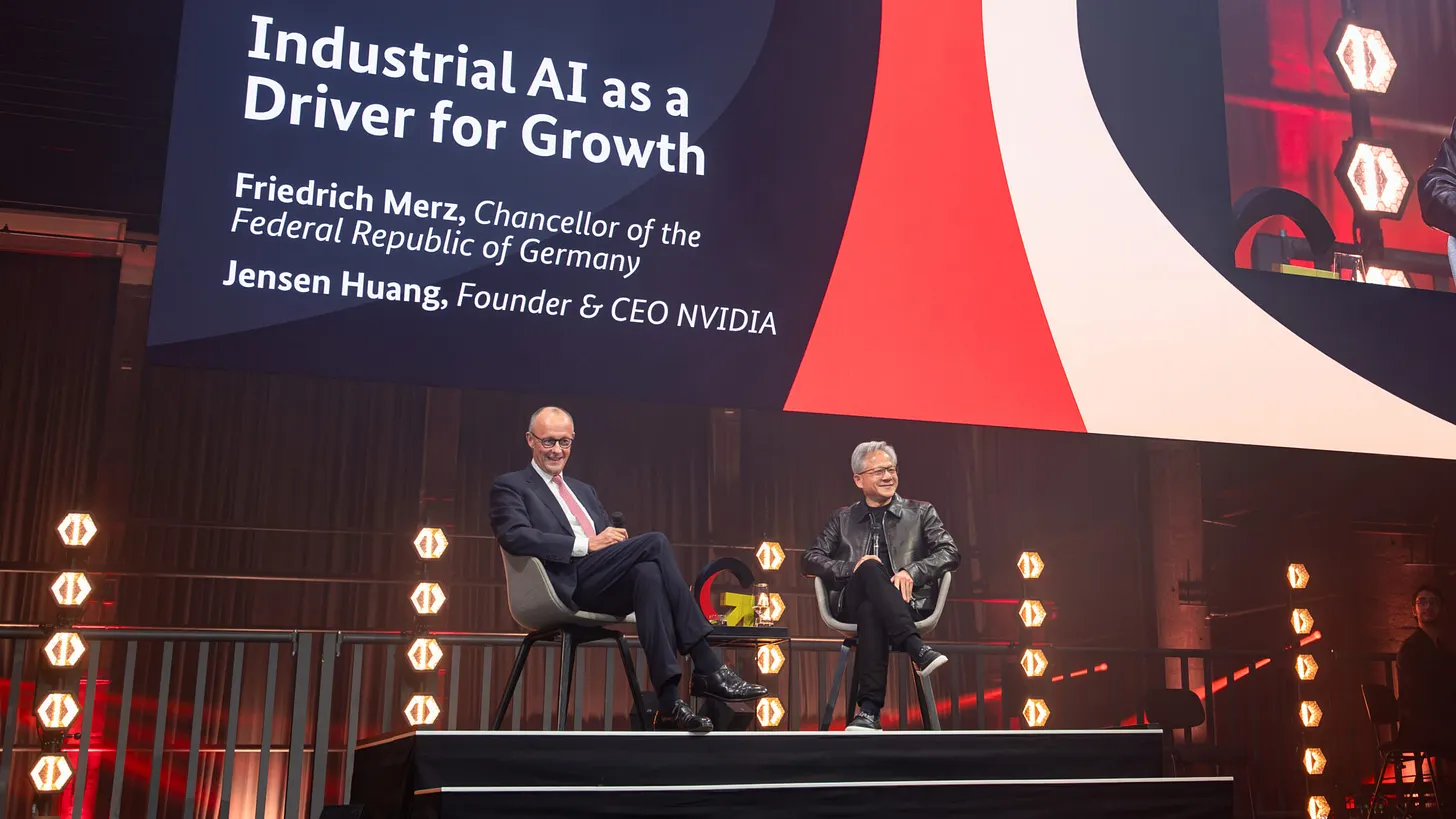
My first week in Berlin has been interesting. On Monday, Jensen Huang sat next to Friedrich Merz in Berlin and told Germany to move faster on AI. On Friday, a few miles away, I spent the day at StageTwo, in an old pumping station on the Spree. I'm back in Europe after a couple of years in Austin, and it was a good way to get reacquainted with the deep-tech scene here. Universities across Europe nominate their best startups, and about 45 of them, mostly spinouts, pitch over a single day.
It felt like a direct reply to what Huang had been saying all week. In London he told British journalists, “I think you overthink things.” In Berlin he called German industry's manufacturing data “your natural resource, it belongs to the nation,” and asked governments to stop debating the technology and regulate what people build with it. At StageTwo, it was a room full of that natural resource, out of the lab and asking for money and commercial guidance.
Out of the lab
Two of the finalists in the room were British. Cloq, from Oxford University, is building a quantum clock around a single nitrogen atom trapped inside a carbon molecule, aimed at GPS and other systems that run on precise timing. Its four co-founders met this summer on an Oxford Edge programme, and two of them are still undergraduates. FreeForm Photonics, from Heriot-Watt in Edinburgh, uses a laser to build alignment features straight into glass, so optical parts fit together without anyone adjusting them by hand. The company says that manual step accounts for more than half of what photonic components cost to make. Nobody was overthinking the science. Cloq went from a summer programme to a European final in about three months.
Most of the panel discussion was about money: growth-stage gaps, EIF megafunds, venture debt. Europe has told that story about itself for a decade. But a lot of that money only arrives years after a spinout decides how big it's going to try to be, and that decision gets made early, by whoever happens to be in the room.
The first room: the university
The first room belongs to the university. The deal a spinout signs with its tech transfer office sets how much equity the university keeps, what royalties the company pays, and how long both sides spend agreeing on it. Cloq brought that room to Berlin with them. Catherine Spence from Oxford University Innovation travelled with the team. Britain has spent three years trying to make these deals faster and more efficient. The 2023 Independent Review of University Spin-out Companies pointed universities to stakes of 10 to 25% for IP-heavy spinouts, and 49 had adopted the guidance within a year.[1] Germany published its own Spin-off Framework in June. According to Atlantic, one of the venture firms involved, it asks for negotiations to close within eight weeks for founders to keep at least 85% of equity at formation.[2]
The second room: the first investors
The second room is the first investors. One story from the panel at StageTwo stayed with me: a Lithuanian medtech founder was raising €14 million. A European VC asked whether that was too much. A US VC told them to go for €40 million.
I've had a version of both conversations. During my time working with startups in Texas, the coaching was basically “what would this look like if it worked?” Here in Germany, I meet founders with seriously good science who build the plan around what they think they can defend in a pitch meeting. That's fair enough on its own, but it adds up.
The third room: the operators
The third room is the hardest to fill: people who have actually scaled a company. Europe's science founders mostly arrive without that experience. The TUM Global Deep Tech Report found that 36 per cent of European deep tech founders had started a company before, against 43 per cent in North America.[3] Only 24 per cent had prior deep tech experience, against 33 per cent. The gap is sharpest in exactly the fields Cloq and FreeForm work in. This year's European Deeptech Report from Lakestar, Walden Catalyst and Dealroom found that photonics and quantum companies come disproportionately out of university labs, and relatively few of their founders have built a startup before.
Europe does have more people who have scaled companies than it used to. Accel and Dealroom count more than 2,300 startups founded by alumni of the region's unicorns.[4] That's how scaling knowledge travels here, from one company's early employees to the next company they found. But those networks run mostly through software companies in a handful of cities. A four-person team out of an Oxford physics department, or a researcher in Edinburgh, sits a long way from that bench.
The investors closest to them are often in the same position. A report this year from The Big Search and Dealroom found that most European deep tech investors have never operated a deep tech company themselves.[5] That changes how the €14 million question gets answered. If nobody around you has scaled a company, it's hard to know your plan is too small, and it's harder still when the person writing your first cheque hasn't either.
Huang touched on this in Berlin without quite meaning to. He told Germany to bring in AI technology but keep hold of what it knows. “You should not export your culture, export your values, export your knowledge,” he said. He was talking about industrial data. The knowledge Europe loses most easily is harder to write down: what someone learned taking a company from five people to five hundred. More of Europe's most experienced founders are now incorporating in the US for its capital and its single market, and that knowledge goes with them.
Fix the timing, not the fund
Fixing this doesn't need a new megafund. The cheaper change is timing. Experienced operators tend to reach science companies late, as Series A board members or senior hires, after the round size and the first market have already been decided. Spinouts need them in year one.
The US has made that a rule in at least one place. Since 2012, the National Science Foundation's I-Corps programme has required every national team to include three people: the researcher who owns the science, someone leading the commercial investigation, and an industry mentor who has taken technology to market before. At Austin Technology Incubator, I came across Saight, a team building real-time AI for colonoscopy that traces the exact edges of a polyp while the clinician is still looking at it. Both co-founders are technical, with PhDs, and the company grew out of their research in computer vision and medical imaging. I-Corps made them bring industry experts and commercial advisors into their earliest customer conversations. The founders hadn't gone looking for that advice; the programme required it. What they heard shaped how they positioned the product and how they approached a medical market that is very hard for newcomers to enter. In Europe, mentorship is usually something a founder goes looking for once they realise they need it. By then, the plan has often already been sized.
Universities can move that earlier too. Standard terms, which both Britain and Germany now have, take the haggling out of the licence. The next step is putting someone in the room who has scaled a company while those terms are being signed, so the plan the deal supports is the right size from the start.
Programmes that put lab teams in front of people who have built companies are one way to close that gap. That's what the Creative Destruction Lab and DEEP Institute are built to do, so I'm not a neutral observer here. Investors can close it too, by bringing operators into the partnership. Some European funds already do this, though the reports suggest it's still the exception in deep tech.
Julia Beck, Chief Growth Officer at eleQton, said something on the StageTwo panel that I wrote down:
“If you keep your benchmark low enough for long enough, mediocrity eventually starts to look like success.”
This article was written by Nessie Chu-Heng Lu, Venture Manager for Compute at the Creative Destruction Lab, ESMT Berlin, and Strategic Marketing Lead at Founders & Funders. It was first published on the Founders & Funders Substack.
- [1]Independent Review of University Spin-out Companies: www.gov.uk/government/publications/independent-review-of-university-spin-out-companies
- [2]Atlantic, Introducing the German Spin-off Framework: atlantic.vc/stories/introducing-the-german-spin-off-framework
- [3]The 2026 Deep Tech Report: table.media/assets/briefings/security/documents/20260325_docs_2026-european-deep-tech-report.pdf
- [4]Accel x Dealroom, Founder Factories 2026 Report: dealroom.co/reports/europe-israels-founder-factories-in-the-age-of-ai-2026/
- [5]The 2026 Deep Tech Report: table.media/assets/briefings/security/documents/20260325_docs_2026-european-deep-tech-report.pdf
About the Author

Nessie Chu-Heng Lu
Creative Destruction Lab, ESMT Berlin
Nessie Chu-Heng Lu leads the Next-Gen Computing stream at the Creative Destruction Lab at ESMT Berlin, where she works with deep-tech startups in quantum computing and photonics. Before moving to Berlin, she was a Senior Venture Associate at the Austin Technology Incubator at UT Austin, where she worked with more than 15 early-stage deep-tech startups on technology commercialisation.
She is also Strategic Marketing Lead at Founders & Funders, Oxford's innovation community.