Drug discovery has a strange productivity problem.
In most industries, better tools make output cheaper and faster. In pharma, the opposite pattern has held for decades. Jack Scannell and colleagues gave it a memorable name: Eroom's Law, or Moore's Law spelled backwards. Since 1950, the number of new drugs approved per inflation-adjusted billion dollars of R&D has roughly halved every nine years.
Put bluntly, each research dollar has been buying less and less therapeutic output; by 2010, a real dollar of drug R&D was contributing only a fraction of what it had in 1950. That means more money, more time, and more organisational effort are needed just to get the same result. It also means that every failure becomes more expensive, which pushes companies toward safer bets, narrower markets, or late-stage assets that feel easier to justify.
Why It Happened
Why has this happened? Part of it is that many of the easier drug targets have already been tackled. Part of it is that the bar is rightly higher: new medicines are expected to be safer, more selective, and supported by stronger evidence than before. And part of it is that biology is complex, and more automation, more data, and more powerful tools do not automatically translate into better decisions. All of this would be troubling in any industry. In healthcare, where ageing populations, antibiotic resistance, and pandemic risk are all rising at once, it makes the need for faster, smarter drug discovery especially urgent.
Starting From Fragments
One traditional way to begin a drug programme is high-throughput screening: test enormous collections of molecules and see whether anything shows activity. That approach has delivered real medicines, so this is not a story of “old bad, new good.” But the molecules it turns up are often already large and chemically complex, and they tend to arrive with problems baked in: poor solubility, off-target binding, developability issues that surface before optimisation has even started.
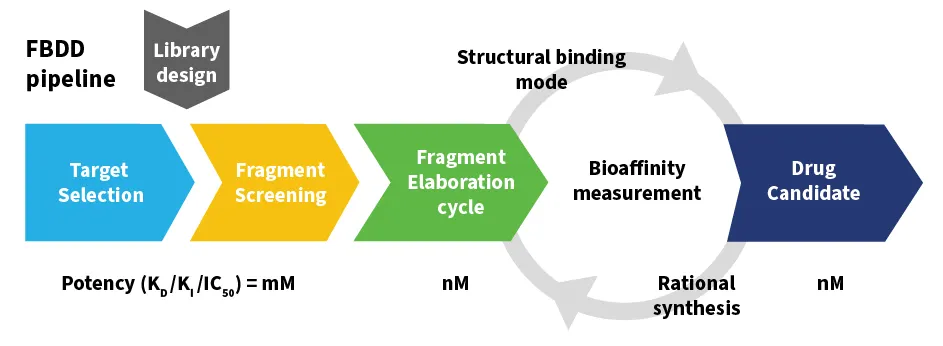
Fragment-based drug discovery starts from a different place. Instead of looking for something close to a finished drug, it starts with very small, simple molecules, more like the first clue than the final answer. These fragments usually bind only weakly, but that weakness is part of the point: they can reveal where and how a therapeutic protein target is willing to interact, and chemists can then build on that clue step by step. Because the starting pieces are small, the libraries are smaller too, which can make the search more focused. The trade-off is that fragment signals are faint and easy to miss, so researchers usually combine several different ways of measuring what is going on. That is why fragment discovery is so tied to the design-make-test cycle: make something, test it, learn from the result, and repeat.
“In that kind of system, a failed molecule is not useless. It still helps define what the target does not want, which can be just as valuable for the next round as a success.”
COVID Moonshot
One striking academic example was COVID Moonshot. It brought together researchers from places including Oxford and Diamond Light Source, the UK's national synchrotron in Oxfordshire and essentially a giant X-ray facility that lets scientists see, at very high resolution, how small molecules fit into viral proteins.
What made Moonshot especially unusual was the model behind it. Instead of following the usual closed, patent-led route, the project shared its data openly as it went and aimed to produce a direct-to-generic antiviral: a drug that, if successful, could be made cheaply and widely without anyone locking up the intellectual property. Because the data was open, chemists from outside the core team could propose compounds and see the results, which kept the design-make-test cycle turning faster than a single closed lab usually manages. It was an attempt to test whether drug discovery could be run not just as a private race, but as a global open-science effort. That made it a powerful demonstration that fragment-based discovery is not only commercially viable, but can also work as a public-good model.
From Method to Market
In 2026, fragment-based drug discovery is no longer a niche academic idea. It has already contributed to six FDA-approved drugs, including medicines for melanoma, chronic lymphocytic leukaemia, tenosynovial giant cell tumour, bladder cancer, and breast cancer. The strongest commercial proof point is probably Astex Pharmaceuticals, the Cambridge company founded in 1999 specifically to pioneer this approach. Its fragment-based platform contributed to Kisqali and Truqap for breast cancer, and Balversa for bladder cancer. In other words, this is not just an elegant scientific concept. It is a method that has already produced real products, real companies, and real market value.
The Shape of the Risk
This is also where it gets interesting for anyone building or backing companies. Fragment-based discovery changes the shape of the risk. The traditional high-throughput screening is capital-hungry up front: you need vast compound libraries, industrial-scale automation, and the infrastructure to run it all before you know if you have anything.
Fragments invert this. It requires smaller libraries and cheaper early cycles, and because the method generates useful information even when a compound fails, a team can learn a great deal before committing serious money.
“For a founder, that lowers the cost of the early swings. For an investor, it means the failures are cheaper, and the commercial signal arrives sooner: you find out what you’ve got before the burn rate gets frightening.”
It's part of why the approach has supported not only individual drugs but durable platform companies like Astex, whose value lay less in any single molecule than in a repeatable way of finding them.
The Purification Bottleneck
My own PhD focused on an important choke point in the early stages of drug discovery: purification.[1] Before a newly made follow-up molecule can usually be tested properly, it has to be cleaned up first, a step that takes time, money, and a lot of solvent. We asked whether some of that delay could be skipped by testing compounds directly from crude reaction mixtures using high-throughput X-ray crystallography. The trade-off was clear: faster cycles, but messier data. So the real challenge became not just generating more results, but learning better from imperfect ones. Our work showed that the apparent failures mattered too. By learning from molecules that seemed not to bind as well as from the ones that clearly did, we could recover missed hits, sharpen the overall picture, and feed better information into the next round of decisions.
Shorter Loops, Cheaper Failures
To me, that is what fragment-based drug discovery is really about. Drug discovery is unlikely to be transformed by one magical technology alone. The bigger opportunity is to build systems that shorten feedback loops, lower the cost of being wrong, and treat negative results as information rather than waste.
This article was written by Harold Grosjean, Associate Scientist at VIB.
- [1]Grosjean, H., Biggin, P.C. Developments and challenges in hit progression within fragment-based drug discovery. Nat Commun 17, 2226 (2026): doi.org/10.1038/s41467-026-68941-z
About the Author
Harold Grosjean
Associate Scientist, VIB
Harold Grosjean is a computational chemist and structural biologist working in drug discovery. He trained in biochemistry and genetics at the University of Nottingham and structural biology at Imperial College London, before completing a DPhil at the University of Oxford and Diamond Light Source focused on making fragment-based drug discovery more efficient and interpretable.
He then worked at Iktos, in Paris, on AI-enabled drug discovery, scientific software and applied discovery projects. He is now at VIB in Belgium, where he helps bridge fundamental science to the market through translational R&D efforts on spin-out projects.