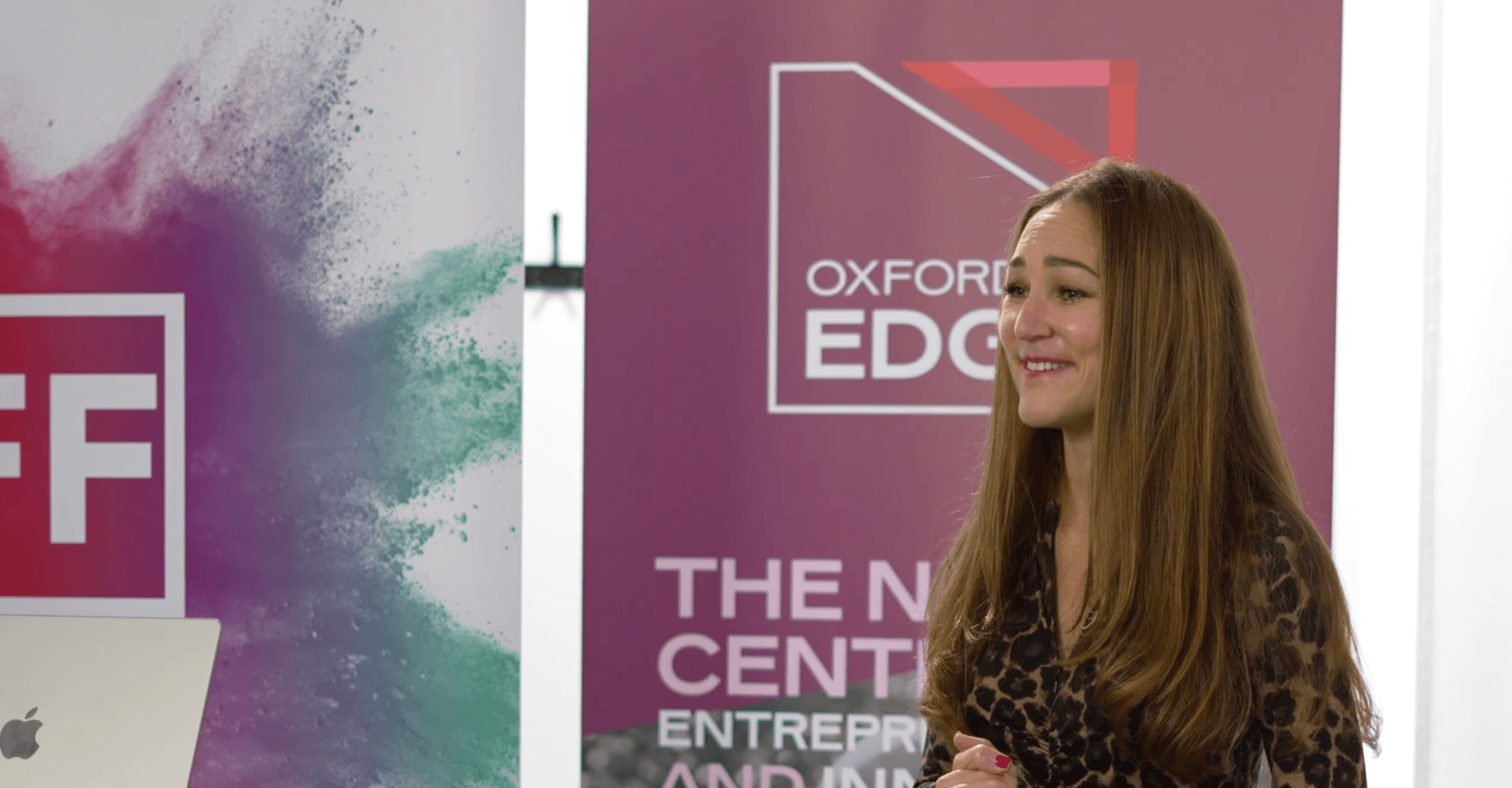
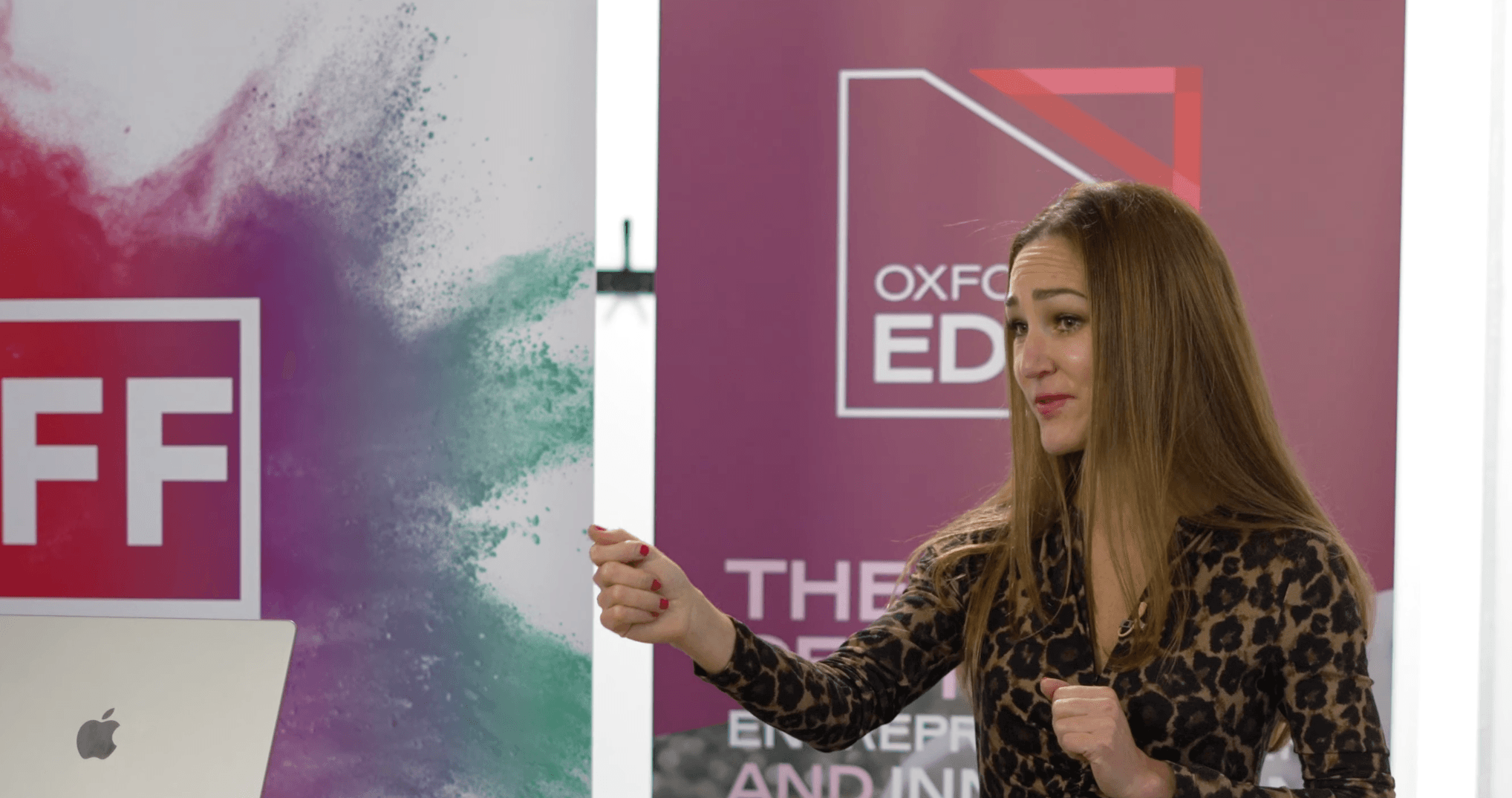
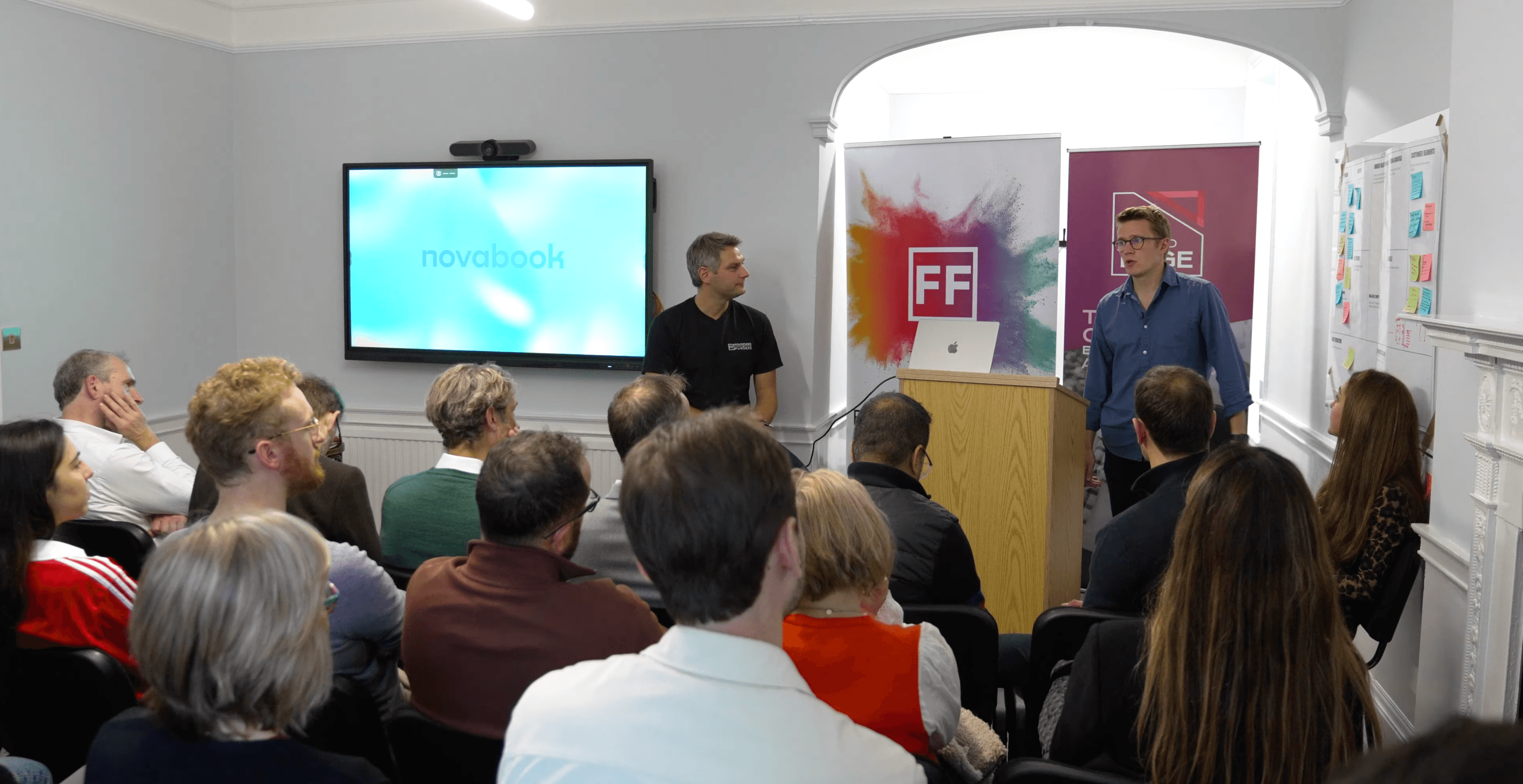
We launched the Founders & Funders monthly series late 2025 to do one thing well: put serious builders in a room and let the conversation go where the experience takes it. The kick-off paired two Oxford alumni whose paths look nothing alike, Cici Muldoon, a quantum physicist building a cancer diagnostic, and Lukas Feddern, an engineer-turned-operator rebuilding start-up finance. What struck us afterwards was how much their stories rhymed. This is what we took away.
Executive Summary
- 01
In deep tech, the science is rarely the hard part. Both founders reached traction by re-routing a technology, model, or market until it fit a real-world pathway, not through a single eureka moment.
- 02
The prize is in the broken process. The strongest opportunities lay in stripping cost, delay and error out of systems people had stopped questioning, not in novelty for its own sake.
- 03
Personal pain produces better companies than abstract ambition. The more serious ventures grew from problems the founders had personally suffered.
- 04
Fragmentation, not scarcity, may be holding the UK back. A pointed critique of Oxford's siloed ecosystem, offered as lived experience, is one we think deserves serious attention.
- 05
Capital is commoditising; what surrounds it is not. Both speakers, from opposite sides of the table, valued operational help and introductions over the cheque itself.
Why This Matters
Britain excels at the first mile of innovation, and the challenge lies in the distance that follows. Its research base produces world-class science, Oxford alone ranks among the top ten globally for spinouts, yet the journey from a discovery to a company that stays, scales and matters at home remains a hard one. Part of the reason is well understood: the patient, specialist capital that science-based companies depend on is still thinner here than across the Atlantic. In the fields closest to Oxford's strengths, the British Business Bank finds the US invests 59% more in life sciences and 27% more in deep tech than the UK, dollar for dollar of GDP.
So some of the companies that do break through go on to leave. Atomico's 2025 State of European Tech report finds that by Series C, more than a third of repeat European founders have moved their headquarters abroad, citing shallow late-stage capital and fragmented regulation, with the United States the most common destination. But capital is only half the story. The deeper problem, as the discussion with Cici and Lukas kept returning to, is one of coordination.
That gap is not an abstraction to us. We spend our time trying to knit Oxford's builders, backers and institutions into something more than the sum of its parts, and the kick-off brought the question down from policy to lived experience, through two journeys that taught the same lessons from opposite ends of the spectrum.
The Central Question
Both stories circle one tension: the gap between what is technically possible and what a system will actually adopt. It is one thing to build a device that detects cancer in minutes, or software that strips cost out of start-up finance. It is another for clinical pathways, regulators, accountants and investors to absorb it. Innovation rarely fails in the laboratory; it fails at the interface with the world. The scarce resource, on this evidence, is less invention than integration.
Key Insights
Five things we took away
The pivot is a method, not a misfortune
Neither business ended up where it began. Cici Muldoon's company, Serox, first analysed the chemical signature of wine through the glass, using laser spectroscopy and machine learning, before turning the same physics, photonics, quantum sensing and AI, towards human health. The leap from beverage to biofluid sounds eccentric until the principle is clear: both are complex dilute liquids whose composition can be read from how they scatter light.
“Biology scares me.”
Muldoon was candid that she resisted the move, telling her chairman she had no wish to go near biofluids. The literature on detecting cancer in urine changed her mind. Serox pivoted in 2022 and is now preparing a US regulatory submission for a non-invasive, point-of-care bladder-cancer test.
Lukas Feddern's path was equally indirect, and he was refreshingly honest about it. His first company, Seneca Learning, was born less of conviction than of a graduate's generic urge to start something. It nonetheless grew past twelve million users and most UK secondary schools before an eight-figure acquisition by GoStudent, where he went on to co-lead AI. Novabook, his current venture in start-up finance, emerged only afterwards, from a costly accounting error during that very exit.
The lesson: durable companies are seldom the product of an original master plan. They are the residue of intelligent adaptation. The skill that matters is not being right first, but recognising the better idea when the work surfaces it.
The value is in the broken process
Strip away the surface novelty and the core opportunity in each venture is the same: a process that is slow, costly, invasive or error-prone, which everyone has quietly accepted as unavoidable.
Muldoon's case rested on a striking claim, that the large majority of cystoscopies, an uncomfortable camera-based investigation, return negative results. If so, many patients endure weeks of anxiety and a procedure they did not need, while systems absorb the cost and genuine cases wait. A rapid urine test at the point of care would not merely showcase clever physics; it would remove delay, expense and fear from a failing pathway.
Feddern made a quieter version of the same argument about start-up finance, which he characterised as needlessly expensive and error-prone because firms stitch together disconnected tools and outsource specialist work, compounding both cost and mistakes. His answer is integrated software that frees human accountants for the judgement-heavy work that genuinely adds value.
The implication: the most defensible opportunities often hide inside processes so dysfunctional that people have stopped noticing the dysfunction. The technology is the means; the broken system is the market.
Personal pain beats abstract ambition
The kick-off's quietly radical point concerned where good companies come from. Feddern observed that many graduates want to start a company in the abstract, and so gravitate towards whatever is fashionable, which is why, he noted, so many near-identical edtech ventures appear. His more serious business came later, from a problem that had personally cost him.
This inverts a common assumption. Ambition is treated as the engine of entrepreneurship, yet ambition detached from a specific, felt problem tends to produce derivative companies in crowded markets. Muldoon's arc echoes the point: her driving obsession was never to be a founder but to understand how matter interacts with light, an obsession that eventually found a problem worth solving.
For those of us building programmes and accelerators, this raises an uncomfortable challenge: success should not be measured by how many people are encouraged to start companies, but our job is to expose talented people to real problems that are worth solving, not merely to encourage them to start things.
Fragmentation, not scarcity
This insight belongs largely to one voice, and we present it as such, though it happens to match what we see every week. Reflecting on why she co-founded the Oxford Angels Network, Muldoon described an ecosystem rich in ingredients but poor in coordination: a set of silos, with institutions and initiatives replicating one another's work and competing rather than combining.
“Everyone's replicating work … and nobody is talking to each other.”
She contrasted this with an American instinct to collaborate, merge and find synergy, and said her own reflex on hearing of a ‘competitor’ is to call them and explore working together. She also challenged the narrow equation of the “Oxford ecosystem” with university spin-outs alone, pointing to the wider constellation of research campuses and independent start-ups across Oxfordshire that fall outside the usual cap tables, and therefore outside the usual support.
If the diagnosis holds, and we think it largely does, it reframes the problem: the intervention required may be less about more money or more incubators than about connective infrastructure: the networks, norms and introductions that let existing resources flow to where they are most useful.
Capital is becoming a commodity
From opposite sides of the table, both speakers converged on the same conclusion: money alone no longer differentiates. Muldoon's angel network is explicitly designed to recruit venture builders and exited entrepreneurs, people who bring more than capital. Feddern, now an angel as well as a founder, framed value in terms of fit and introductions rather than cheques.
The implication for investors is direct: as capital commoditises, the premium shifts to operational support, distribution and trusted networks. For founders, it argues for choosing money by what travels alongside it.
What To Do About It
If you are a founder
Begin from a process that is painful, costly or invasive, ideally one you have endured, and design around removing that pain. Hold the idea loosely; the version that succeeds is often two pivots away from where you start. And when you raise, weigh investors by the operational value and introductions they bring, not the valuation alone.
If you are an early-stage investor
Compete on contribution rather than terms. Build and signal genuine operational support, and widen the aperture beyond university spin-outs to the founders and campuses outside conventional deal flow. When a portfolio company meets a ‘competitor’, test for collaboration before you assume conflict.
And for the rest of the ecosystem
For universities, the prompt is to reframe technology transfer around end-to-end pathways, regulatory, clinical, commercial, rather than the moment of discovery, and to connect researchers early to the operators who define real-world adoption. For those of us building the wider ecosystem, the lesson we take most seriously is to treat Oxfordshire's clusters as one system rather than a set of rivals, and to invest in the connective interface between them. That is, candidly, much of why Founders & Funders exists.
Takeaways
The F&F Five
- 01
Plan to be wrong twice. The winning idea usually arrives a pivot or two after the one you set out with, so build for adaptation, not for being right first.
- 02
Hunt for processes people have given up on. Accepted dysfunction, the invasive test, the bloated cost, is where defensible markets hide.
- 03
Solve a problem that has cost you something. Felt pain points to real markets; abstract ambition points to crowded ones.
- 04
Suspect the silos before you blame the scarcity. Where an ecosystem looks under-resourced, ask first whether its resources are simply not connected.
- 05
Judge money by what it brings besides money. As capital commoditises, the operators and introductions attached to it become the real differentiator.
Watch the Full Conversation
To hear the full discussion and explore additional insights from Oxford's innovation ecosystem, watch the complete conversation on YouTube.