Emily Gill won a government grant this year to build the next version of LEVRA, the company she co-founded during her MBA at Oxford University. There's an Innovate UK award, a place on Oxford Saïd Business School's flagship human leadership programme, and a summer spent working with students from more than sixty countries. So when I ask who the LEVRA product is for — which customer, which market — I'm expecting the tidy answer that tends to come with that kind of run.
“To be totally honest,” she says, “I don't think we have product-market fit yet.”
It's not the sort of thing founders tend to say out loud. Gill says it easily, and the rest of our conversation makes clear that this isn't false modesty; it's the centre of how she and her co-founder built LEVRA — product iteration and pivoting based on user feedback and market trends.
To see why, it helps to go back to when she was a lawyer.
The room you learned in
Emily Gill spent seven or eight years in law, most of it at Clifford Chance, and learned the job the way people did back then: being in the office seventy or eighty hours a week, next to a partner for twelve of them, picking up how to handle a nervous client or a tense negotiation just by being in the room. Nobody ran a seminar on any of it. You absorb it — osmosis, she calls it — or you didn't.
There's a catch in how she learned it, though. The seat next to the partner, the twelve hours a day of listening in — that wasn't available to everyone. It came with getting into a prestigious law firm like Clifford Chance in the first place. The people who most need to practise these skills are usually the ones with the least access to a room like that. So a lot of what drives LEVRA is trying to widen that door: to give people a way to practise the things you mostly picked up by being on the inside.
She noticed later, watching younger lawyers and the school-leavers she works with as Chair of a board of governors, that the physical room was going away, and the skills weren't coming with it. That gap is the whole premise of LEVRA. It assesses people's human skills — communication, decision-making, handling conflict — and then trains them to get better: the soft, hard-to-teach capabilities that used to be picked up on the job and increasingly aren't.
The VR detour
When she started her MBA at Oxford's Saïd Business School and further developed this idea with a couple of other people in her cohort who were equally passionate about the human-skill gap, for a while they thought the answer was virtual reality. The research evidence was engagement: people in a headset were four times more engaged, she says, and came out of a session far more confident. So for the first eighteen months, LEVRA focused on this VR experience. Then scaling became a bottleneck for this business model.
She recalled one client wanted the same session run in London, Hong Kong and New York on the same day, and because VR meant someone had to physically be in the room, headset in hand, the co-founders ended up phoning friends from her MBA class to ask if they could cover the other cities. The thing that made VR effective for skill development — being in person and walking someone through it — was what made it impossible to scale for LEVRA at that stage.
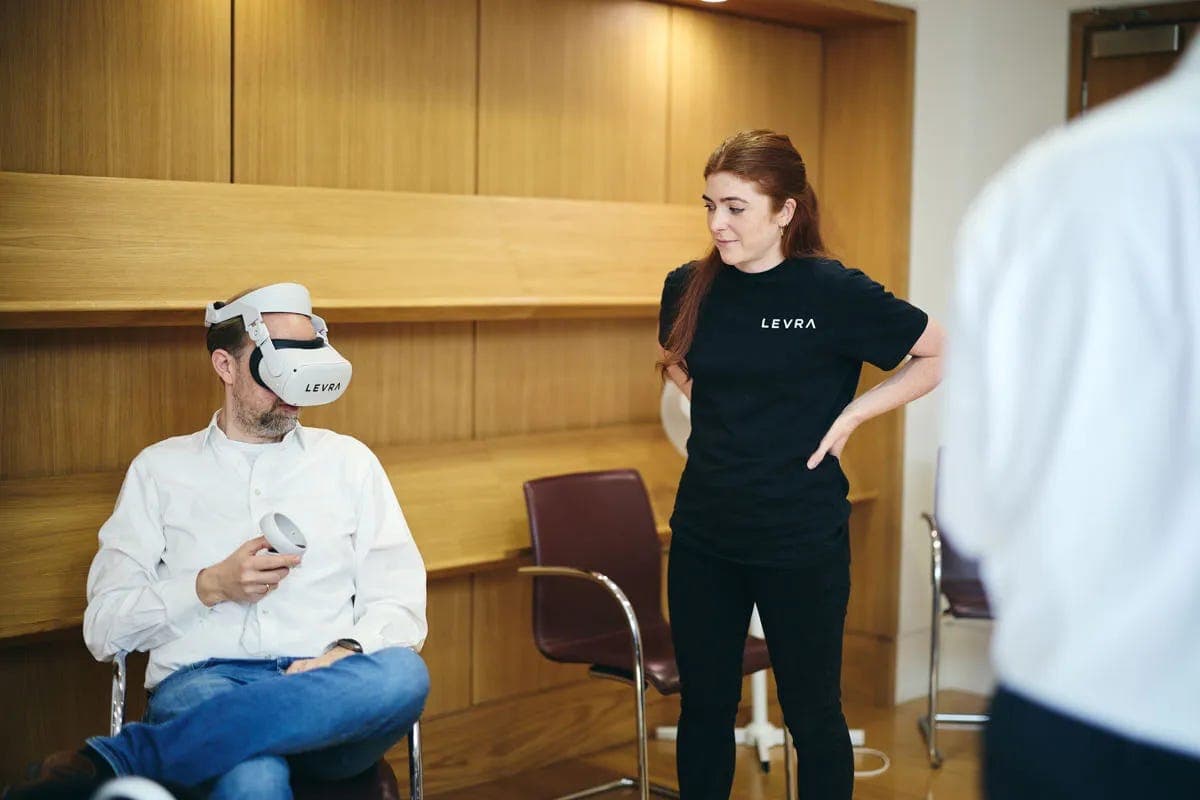
By then, the market was moving too. People were losing interest in the metaverse and turning toward AI, and Gill could feel the ground shift under the product at the same time she was hitting its limits from the company's operations. So they parked this idea and built their own platform instead, something they could deploy without flying anyone anywhere.
“You have to be receptive to what customers are telling you, but also the wider economy as well.”
She's careful to frame this as a commitment to the problem rather than to any one solution. The problem doesn't change, but the way you solve it changes fifty times.
This way of thinking didn't come naturally to her. Law had trained her the opposite way — there's always an answer, always a solution, everything black and white. Building a company meant sitting in the not-knowing for long stretches, and she's candid that it was hard, more mentally than anything else. At some point she read a book called How Not to Know[1] and found it so exactly right for what she was going through that she emailed the author to tell him. He wrote back, slightly baffled: he'd never written it with entrepreneurs in mind. She thought that was funny, and also beside the point — it described the founder's condition better than most things written for founders.
Putting a number on the unmeasurable
LEVRA eventually settled on developing a tool for human skills measurement, instead of a VR headset. Before anyone starts a programme, they take the LEVRA Human Skills Framework that scores them across thirty-one human skills — decision-making, conflict resolution, negotiating, accountability, influencing others, and so on — built with psychometricians and grounded in Oxford research into which skills workplaces were missing.
Gill insists that this isn't a personality test. LEVRA doesn't tell you your type. Instead, it tells you, against defined behaviours, where you're strong and where you have room to grow, and then it provides you with short lessons and practice scenarios aimed at those gaps. The point is to bring self-awareness: most people genuinely don't know whether they're good at communicating or handling conflict, and self-awareness is the first step in improvement.
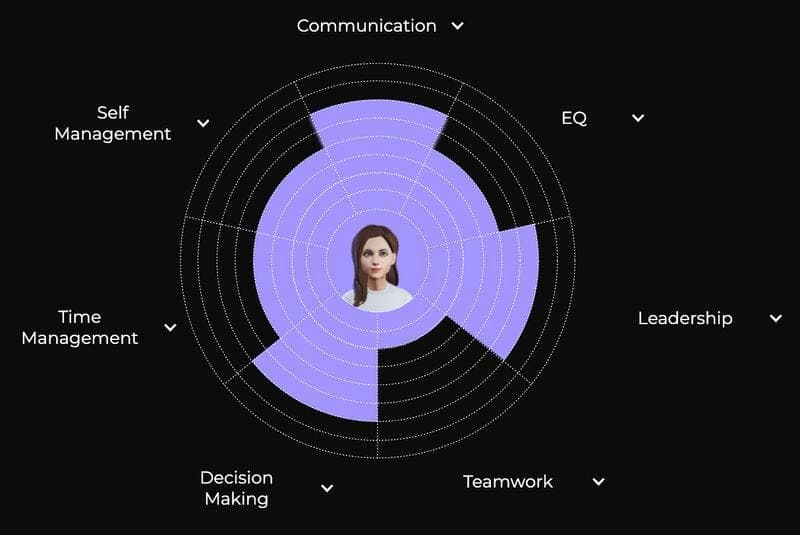
The objection to this is that you can't put a number on it — that trust and judgement and knowing how to read a room aren't the sort of thing that easily shows up on a scale. Gill's answer is behavioural indicators. Each of the thirty-one skills is broken down into defined behaviours you can observe: not “are you a good communicator” in the abstract, but whether you do the specific things good communicators do.
To check they weren't inventing their own private framework, the team mapped their skills against the ones used by the likes of PwC and the World Economic Forum, and found the overlap heavy. The difference, she says, is that most other psychometric tools are self-assessed — you rate yourself — whereas LEVRA is trying to assess the skill from behaviour, in something closer to real time.
Building the simulator
The grant LEVRA received from Innovate UK is funding the next version of this: an interactive AI avatar learners can hold a real conversation with, which reads their behaviour in the moment and points them toward their stronger and weaker skills.
There's an irony to this that Gill acknowledges — using AI to build the very human capabilities she thinks AI makes more valuable. Her argument runs in two directions. On one side, AI raises the premium on human skills: everyone now has the same AI models and gets roughly the same output from them, so what separates one person, or one firm, from the next is judgement, trust, communication, decision-making. The mundane drafting and document review she once did as a junior lawyer is now what the models absorb.
On the other side, the same shift is slowly removing the places people used to develop those skills. The apprenticeship she had — the partner's office, the twelve hours a day of listening in — has thinned out in a world of hybrid and remote work. Fewer people are in the room to learn by being in it. That's the gap LEVRA is trying to fill: not to replace the room, but to give people somewhere to practise when the room isn't there. And this, she argues, is where a person's value migrates as the tools get better.
The avatar isn't there to replace human contact — she's emphatic that LEVRA is pro-relationship, pro-office, pro-actual-conversation. It's a place to rehearse before the real interactions. She reaches for the example of Formula One: drivers spend hours in simulators not to avoid the track but to arrive at it ready. The worry that people will simply learn to game the AI she takes seriously but thinks is fading — the models are good enough now that the conversation feels real, and a lot of the framing happens before a learner ever starts a session, in setting the mindset that this is training, not a test to be beaten.
Selling without the receipts
Part of what makes the assessment work is that the results stay private. An individual's scores go to them and no one else. LEVRA is deliberate about this design; they want the platform to be a safe space, somewhere people can be honest about where they're weak without it counting against them, because the whole business depends on self-awareness and nobody is honest about their weaknesses when they think the boss is watching.
However, this privacy makes selling to the enterprise awkward. The organisation paying for the programme doesn't get to see how any individual scored; the most it gets is aggregated, anonymised scores and measurements across a cohort — this group improved seven percent over two weeks. So the pitch can't lean on individual results, which is what a buyer most wants to see. Gill has to sell the outcome instead of the receipts, and prove the return on investment at the level of the whole group.
“Selling into large organisations is its own skill,” Gill says. The buyer is seldom obvious. Approvals move through layers of sign-off, and timing is everything — approach a firm mid-restructuring, while it's laying people off, and no amount of framing will get it to invest in developing staff. In B2B sales, the pitch is less about the product than about consequence: here is what it costs you when someone turns up unable to handle a client or defuse a conflict, and here is the reputational damage that follows. Four years in, she and her co-founder are still running sales themselves, because the pipeline isn't refined enough yet to hand off.
“You don't learn it from a business-school framework. You learn it by getting it wrong, hearing no, and working out afterwards what you said that didn't land.”
Who needs it most
LEVRA started with selling to professional services — law firms, insurers, the big graduate employers Gill and her co-founder knew from the inside; he'd been at Deloitte, and she'd been at Clifford Chance. These customers still make up most of LEVRA's business to this day. But that's also the market Gill has started to question. If someone has already made it into a firm like that, they probably arrived with a fair amount of what LEVRA teaches.
She suspects that the sharper need might be elsewhere: the sixty-five million young adults out of work globally, the million in the UK not in education, employment or training. That's the gap she keeps thinking about these days — the distance between finishing your education and being able to hold down a job — and it's the reason the question of who LEVRA is really for is still, deliberately, open.
I asked her what the next year holds for LEVRA, and the answer is: keep refining the product based on customer feedback, build out the team, and push harder into the unemployed market. On the team, she's blunt about what growth requires — getting to the point of hiring people who are better than she and the co-founder are at specific things, sales being the obvious one, so the company can move faster than a founder running her own pipeline ever could. This is the same instinct that runs through everything else she says. Hold the mission still; let the rest be replaced by something better.
The muscle you stop using
Which brings us back to where the conversation started. Gill thinks the human-skills problem gets larger and stranger as AI gets better at autonomous, routine work. She expects people to want real human contact more — the concerts, the weekends off their phones — even as more of daily life runs through machines.
What worries her is what she calls cognitive offloading: hand enough of your thinking to AI and the muscle weakens, the same way it does with anything you stop using. Automate the boring parts; she's happy with that. But she wants people to be deliberate about which parts they keep. That, in the end, is what LEVRA is trying to protect — not skills for their own sake, but the capacity to think, judge, and connect that makes someone more than the tools they use.
This article was written by Nessie Chu-Heng Lu, Strategic Marketing Lead, Founders & Funders.
- [1]How Not to Know by Simone Stolzoff.
About the Builder

Emily Gill
Co-Founder, LEVRA
Emily Gill is a TEDx speaker, one of the Top 50 UK Women in Tech, and Co-Founder of LEVRA, an award-winning EdTech company helping to address human skills gaps in the AI era, particularly within early-career talent.
Emily is a former banking and finance lawyer at Clifford Chance. She holds an MBA with Distinction from the University of Oxford (Dean's List), is a Certified Professional Co-Active Coach (CPCC), and chairs the governing board at Harris Clapham Sixth Form.
In 2026, Emily was one of 61 female founders to win Innovate UK's Women in Innovation Award, selected from 1,590 applicants, and was nominated for Business Leader of the Year at the Women and Diversity in Law Awards.