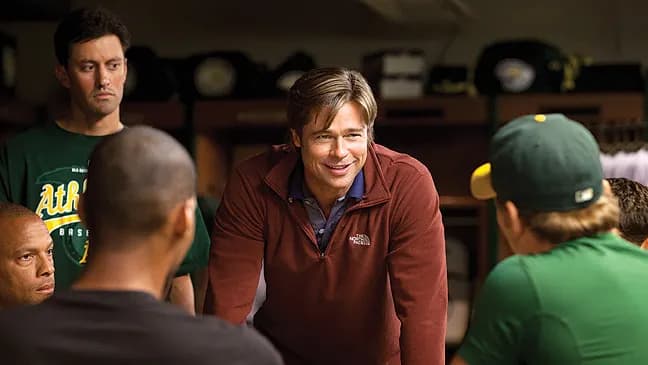
There is a scene early in Moneyball — the film, not the book — in which the Oakland A's scouts sit around a long table. They debate prospects whose names are on the board for transfer. “Who do you want to talk about first?” asks Brad Pitt, playing Billy Beane. One player has “a good face” and a “good jaw.” Another has “a baseball body.” The men nod and murmur in agreement. In 2002, this was how America's best baseball minds chose which players to recruit.
It was called the ‘eye test’.
The point of the scene is not that the scouts were stupid. The point is that intelligent humans, when asked to predict something they cannot quantify, default to pattern-matching against visible traits and call it judgment. In the movie — and the book — Billy Beane brings in a Yale economics graduate with a spreadsheet, on-base percentage replaces the look of a player's jaw as a predictive variable. Within a decade, every team in the league will have a quant department.
As an emerging manager learning the ropes of investing, I think venture is in its ‘Moneyball moment’ today.
Two Minutes Nineteen Seconds
Let's start with the fact that investors don't actually spend very much time evaluating founders. Gompers, Gornall, Kaplan, and Strebulaev surveyed 885 institutional VCs across 681 firms and found that the median fund considers around 100 deals per investment. The median fund logs 118 hours of due diligence for each closed deal — 81 for early-stage, 184 for late-stage. That sounds quite substantial until you remember it is the total spread across weeks, associates, and the gaps between other deals. DocSend's pitch deck benchmark, run across thousands of investor sessions, puts the first-look average at under 2 minutes and 18 seconds. Venture capitalists spend ten times less time on a founder's deck than the typical person spends picking a Netflix show to watch. Most decisions are made in the spaces between other decisions, often with worse information than you'd have when deciding where to go on holiday.
On top of how little time investors spend evaluating founders, consider that we don't have much to go on and can't often define what we saw or didn't see. Huang and Pearce's 2015 paper on angel investors found that the decision was dominated by what investors themselves called ‘gut feel’ — a tacit combination of intuition and analysis in which, when the two disagreed, intuition won and the investor could not fully explain why. This sits atop nearly half a century of psychology, from Nisbett and Wilson (1977) onward, demonstrating that humans are systematically worse at explaining the determinants of their own judgements than they think — and that the confidence with which the explanation is offered is uncorrelated with whether it is right. Nearly the same proportion of venture capitalists indicate (when surveyed) that they are above average in their industry as the number of drivers who report that they are above average drivers when asked.
The Village Talks
Then consider the herd. Scharfstein and Stein's 1990 model in the American Economic Review showed why following the consensus is rational behaviour rather than cowardice: if you back the herd and you're wrong, you're wrong with the room, and you keep your job; if you back the contrarian view and you're wrong, you're wrong alone, and your job is harder. When a company needs capital to get to scale, it normally raises it from multiple sources that support each other and step in and out between rounds. It takes a village, and the village talks. We're all ‘contrarian investors’ — except that in order for the plates to keep spinning, we very much are not able to be.
Bikhchandani, Hirshleifer and Welch formalised the next step in 1992 — information cascades, where after a sufficient number of actors make the same call in sequence, the rational move for everyone downstream is to ignore their own information and copy the herd. “Who is your lead investor?” This is what the industry calls ‘signal.’ It is what statisticians call endogeneity.
Consider, then, what investors claim they do not look at but really do.
Brooks, Huang, Kearney and Murray, writing in 2014, ran identical pitches voiced by men and women in front of investors. 68.33% of participants chose to fund the male-voiced pitch versus 31.67% the female — same words, same numbers. In their field-data sample of three pitch competitions, male entrepreneurs were 60% more likely to win, and attractiveness produced a further 36% boost among the men; among women, attractiveness did nothing. Kanze and colleagues later found that VCs ask male founders promotion-framed questions (‘how will you win this market?’) and female founders prevention-framed ones (‘how will you defend against churn?’); the asymmetry alone predicts a roughly sevenfold funding gap.
Investment decisions are affected by weirder stuff too. How much a founder smiles moves the needle more than the things investors say they are looking for. Founder smile intensity correlates with Y Combinator admission. I'll repeat that: the more you smile in your pitch, the more likely you are to get into YC — statistically speaking. My favourite weird and wonderful academic paper this month — Bahlmann's 2024 Frontiers in Psychology study of 341 male VC–male founder dyads — found that the less attractive the male VC is (based on other people's scores), the more capital he committed to relatively more attractive male founders (i.e., how attractive other people scored that founder to be).
We project at a deeply subconscious level that is quite challenging to regurgitate into our CRM. Ambady and Rosenthal's thin-slice work — judgements made in under thirty seconds match judgements made over thirty minutes — explains why every effort to slow the process down tends to confirm the snap call rather than overturn it.
So we make instant decisions, are unable to define why we did, follow each other even as we advertise that we don't, and are still fundamentally driven by the human forces that drive all of our decisions at a subconscious level.
Put it together, and you get an industry making capital allocation decisions in three to four minutes, copying the partner across the road, and rewarding founders whose jaw is, presumably, a good shape for baseball.
The question is whether any of this is fixable — and a growing number of funds think the answer is yes, if you're willing to replace the eye test with something more rigorous.
Enter the Quants
In the last few years, we've digitised more and more of the ‘signal’, the venture market has filled with more competition (for the best talent), and AI has unlocked the ability to make instant decisions more rigorously. From this context has emerged new funds that take a quantitative approach to selecting which founders to back.
Correlation Ventures has been running a co-investment model for over a decade — explicitly statistical, with a stated devotion to making investment decisions in under two weeks based on the model's output. SignalFire built data infrastructure around employee relocation patterns to surface companies that their human partners would never have found through warm intros. EQT Ventures developed an internal system called Motherbrain that ranks opportunities ahead of any human seeing them. Quantum Light, founded by Nik Storonsky of Revolut, claims to be fully quantitative — no qualitative override. Moonfire — in the UK — is also leaning into the positioning of a ‘quant VC’ with more engineers than investors and a proprietary ML screening of ~50k companies per week.
What these funds have in common is a wager: that the parts of venture decision-making which are automatable have been left untouched not because they cannot be automated, but because the people doing the deciding had no incentive to find out. That the old way — which justifies their role — was the right way.
“You don't put a team together for the computer, Billy... Major League Baseball thinks the way I think, you're not going to win.”
The New Guard
I've really enjoyed learning how top funds are approaching the problem in the last year and the new guard leading the charge. Ashley, at NEA, has been someone really insightful in terms of how to think about streamlining outbound sourcing and the plumbing of venture capital. I've been impressed with Damian and Felix's work at Rule30 — “an AI research lab building systematic strategies to identify and back outlier founders at scale”. It's not just their work automating parts of the VC workflow, but also their open vision — thinking about networks, collaborating, and learning — which has impressed me and, frankly, impressed upon me the necessity of doing the same.
What is automatable, on the evidence so far, is uneven but apparent in each stage of venture capital. Take sourcing — GitHub commit patterns, LinkedIn delta, conference rosters, Twitter graph analysis. Take screening — career trajectories, prior exit history, time-to-first-hire, the speed of a founder's previous zero-to-one, deck parsing, ARR sanity-checks, comparables. With large language models in the stack, the pitch transcript can inform sentiment, videos can betray biases (or ‘taste’) — and perhaps more. None of this is the whole job, but all of it is a part of the job which, until recently, was being done by an apprentice model of venture which is fundamentally changing.
Beating the Baseline
The objection, of course, is that the power law is by definition resistant to prediction. Babe Ruth was a slugger. The biggest outcomes are outliers, and outliers are not where statistical models live. True, but it may also be slightly beside the point.
The starting point is not a sophisticated process being marginally improved. The starting point is under 2 minutes and 19 seconds on a deck and a partner saying ‘I don't see it.’ Almost any quantification, applied to almost any part of the funnel, has the opportunity to beat that baseline.
“The Moneyball lesson was never that Peter Brand could spot the next Babe Ruth. It was that Brand could identify the players the scouts had systematically underpriced.”
The equivalent in venture is not predicting the next Stripe. It is identifying founders that the market was excluding for reasons unrelated to their potential performance.
There is so little data at early-stage startups that perhaps this is how human judgement earns its keep and gets on base. Surely picking out the moonshot needs a human in the loop — for the ‘intangibles’. How could a machine see what hasn't happened before? You need to dream up the truly novel — see around walls, run through walls, throw your hat over them.
It may also be true we're looking at venture through rose-tinted glasses of the past. Steve Jobs. Silicon Valley. Swinging for the fences. We've romanticised venture over generations into the hero's story that it becomes almost impossible for us — as founders, investors, or readers — to believe that all of this can be boiled down to numbers.
Because venture is fundamentally romantic.
“It's hard not to be romantic about baseball.”
About the Author

Michael Hutson
Partner at Oxford Seed Fund · Associate Fellow at Oxford Saïd Entrepreneurship Centre
Michael Hutson is a Partner at Oxford Seed Fund and an Associate Fellow at Oxford Saïd Entrepreneurship Centre. He is interested in exploring quantitative methods in venture capital and swapping notes with other investors innovating in this space.